The Modular Myth: Why "Factory-Built" Isn't the Silver Bullet for Victoria's Housing Crisis
Research & Analysis | Victorian Construction Market 2024–2025
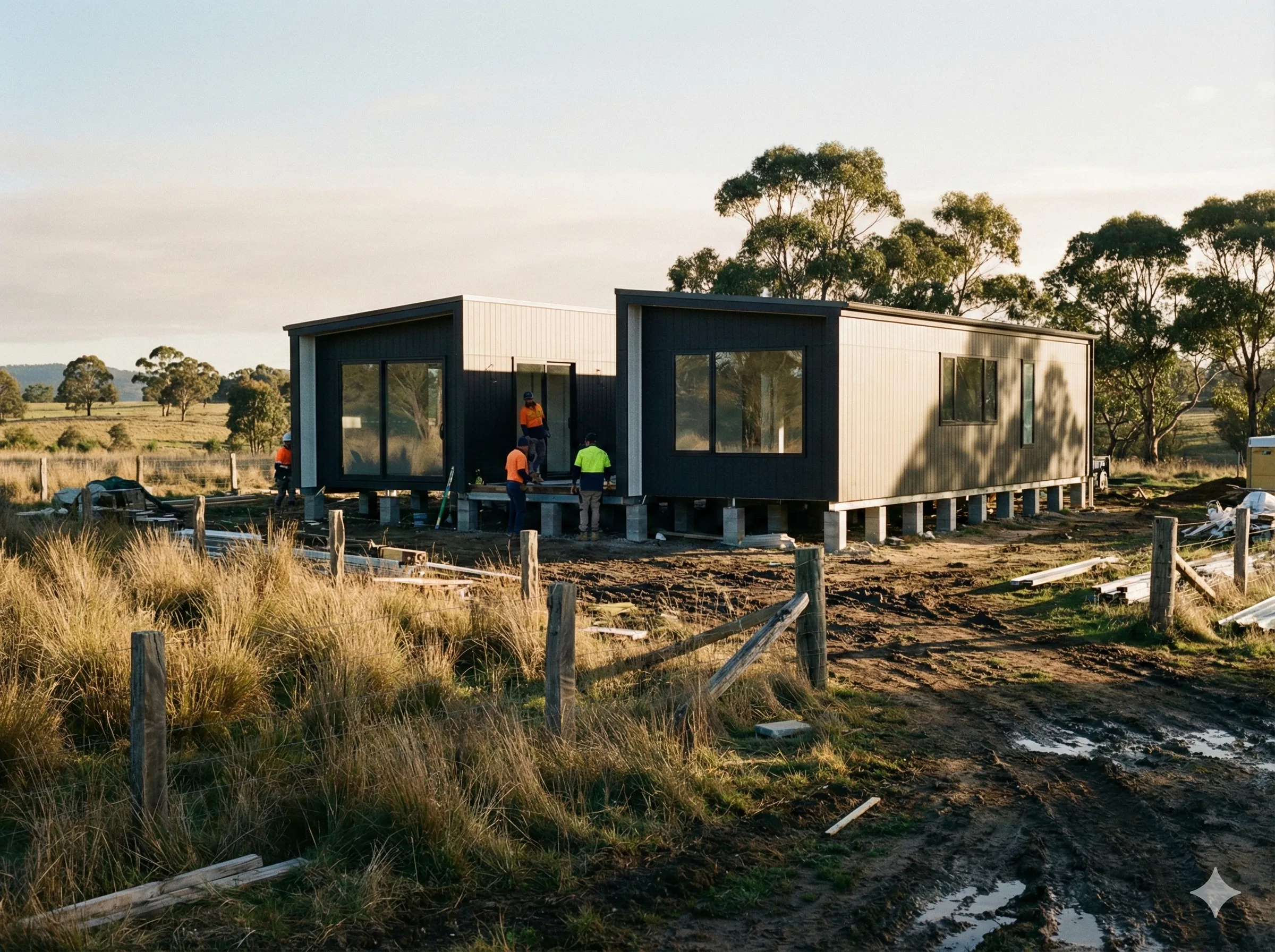
A persuasive narrative has taken root in Australia's housing debate: that modular and prefabricated construction can deliver homes faster, cheaper, and at a scale large enough to materially shift affordability. Governments and industry advocates have leaned hard into this idea, with headlines claiming "100k homes assembled like Lego could solve Australia's housing crisis" and new injections of public funding aimed at expanding manufacturing capacity.[1]
The premise sounds simple—move construction indoors, eliminate weather delays, use factory labour instead of site labour, and enjoy the same efficiencies that transformed the automotive sector.
Yet when the numbers for Victoria in 2024–2025 are unpacked, the promise doesn't land. For most custom residential projects, any theoretical cost advantage evaporates under the pressure of logistics, regulation, finance friction, and compliance with updated energy standards.
This analysis breaks down the specific mechanisms that are keeping modular construction expensive in Victoria, and why broad claims of universal savings don't survive contact with real projects.
Myth 1: "Modular Is 20% Cheaper Than Traditional Building"
Reality: Once delivery, assembly, and site works are included, modular homes are often 10–15% more expensive than an equivalent site-built home in metropolitan Melbourne.
The misconception usually originates from ex-factory "base prices"—for example, a pod advertised at $150,000 for a compact two-bedroom unit.[2] The number is technically accurate for the module as it leaves the factory gate. It is not a price for a finished home.
A detailed review of builder inclusions [3, 4] reveals a persistent and significant gulf between the advertised factory price and the true turnkey cost.
The "Stitching" Tax
A modular home arrives in separate volumes that must be craned into position, joined structurally, and finished aesthetically. Marriage-line work requires plumbers, carpenters, and plasterers to travel to the site to waterproof, patch, insulate, and finish internal linings. This reintroduces the very inefficiencies modular construction claims to avoid.[5, 6]
Foundation Premium
Modular homes cannot sit on standard waffle-pod slabs, the cheapest foundation type in Victoria. They require engineered foundation systems designed for craning stresses and point-load distribution. Common systems include Surefoot footings (steel-driven footings supporting up to 36 tonnes each), screw piles ($150–$300 per pile installed), or concrete piles for heavier loads.[7] The number of footings varies significantly based on the system chosen, building size, and soil conditions—typically ranging from 12–30 footings for a standard residential footprint, not the 40–50 often assumed. Foundation costs typically range from $8,000–$20,000 depending on the system and site conditions, still representing a premium over standard slab foundations.
Effective Cost Comparison (150m² Build)
Modular reaches parity with Traditional Custom builds once logistics are added.
Myth 2: "Delivery Is Just a Truck Ride"
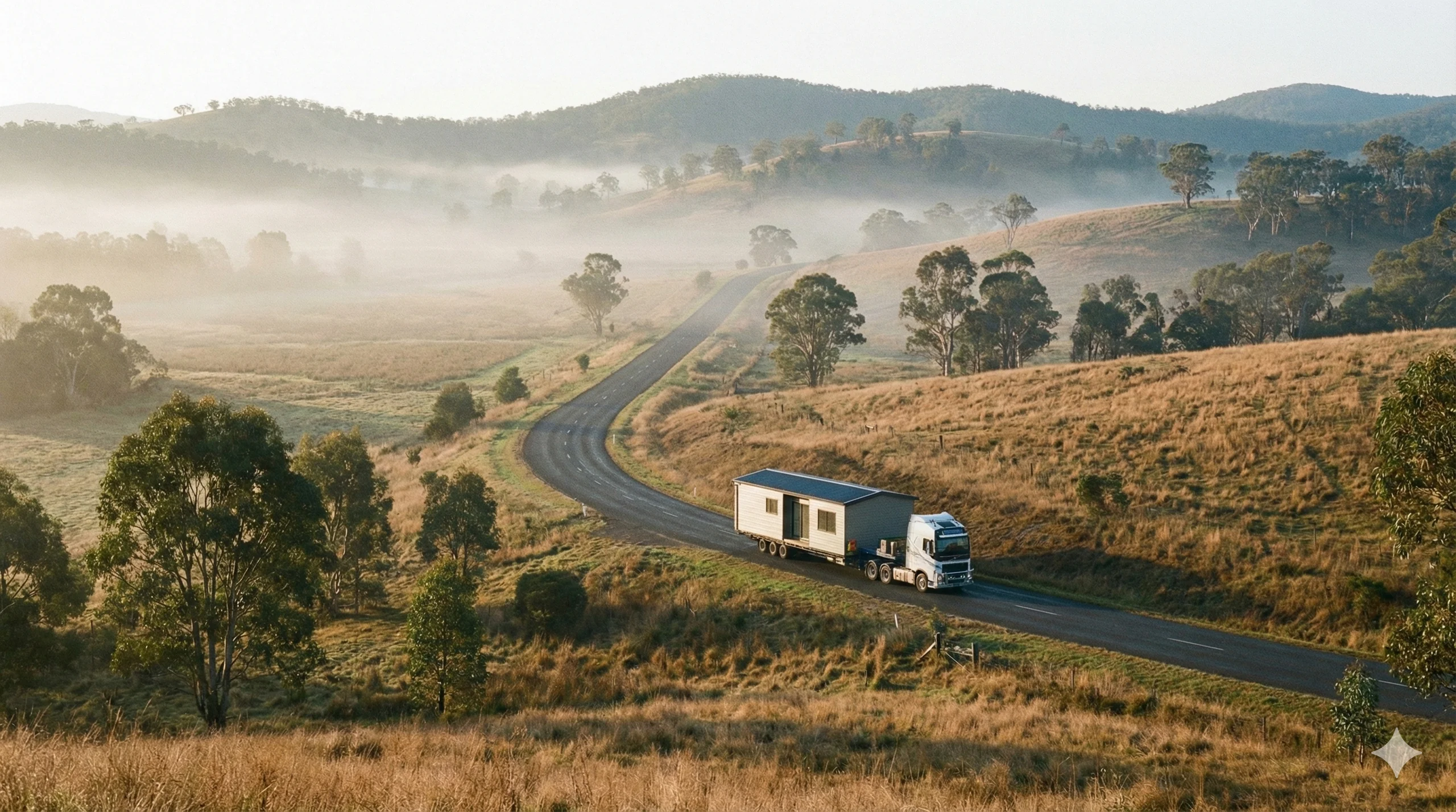
Reality: In Victoria, transporting a modular building is a tightly regulated oversize-load operation that routinely adds $20,000+ to a project.
The most underestimated cost driver is the regulatory environment overseen by the National Heavy Vehicle Regulator (NHVR) and Department of Transport and Planning (VicRoads).
The Width Thresholds
Under NHVR regulations, modular homes face escalating pilot vehicle requirements based on width. Modules under 3.5 m wide (and under 26 m long) require no pilots. Between 3.5 m and 4.5 m width, one certified pilot vehicle is typically required. Above 4.5 m width, the requirement escalates to two or more certified pilots, plus route approvals and traffic management.[8] Most modular homes fall in the 3.5–5.0 m range, meaning certified pilot vehicles are standard, not exceptional.
Certified Pilot Vehicle Costs
Certified pilot vehicles charge $200–$350 per hour, plus mobilization fees and minimum call-out periods.[9] For a typical 200 km delivery requiring two pilots, this adds $2,000–$4,000 to transport costs. The requirement escalates with width: a 5.0 m wide module may need three pilots, while modules over 5.5 m can require four pilots—each adding to the hourly rate.
Route Surveys and Permits
Before issuing a permit, NHVR and VicRoads may require a detailed route survey assessing bridge heights, clearances, tram lines, and powerlines.[10] If utilities must lift lines or if route modifications are needed, the builder pays for the crew and any infrastructure work. These aren't edge cases—they are routine for deliveries to established suburbs where overhead infrastructure is common.
Myth 3: "Factory Labour Is Cheaper"
Reality: Labour markets and union agreements have largely eliminated the assumed cost gap between factory workers and on-site trades.
The theoretical advantage hinges on factory workers being covered by manufacturing awards instead of construction awards.[11, 12] In practice, modular factories need licensed electricians, plumbers, and carpenters to perform the same work they would on-site.
In 2024–2025, with skilled labour shortages in both manufacturing and construction, factories routinely pay near-site rates to attract and keep qualified trades. Industrial relations activity—particularly by CFMEU and AMWU—has further narrowed the gap.[13]
The "factory labour arbitrage" that once underpinned modular cost models rarely survives in Victoria's current market.
Myth 4: "Finance Isn't an Issue Anymore"
Reality: Most lenders still treat modular builds as materially higher-risk until the modules are permanently fixed to land.
CBA's recent announcement enabling progress payments for accredited manufacturers is a step forward, but it covers only a narrow slice of the industry. Many small and mid-sized modular builders fall outside these frameworks.
Two persistent obstacles remain:
No Asset, No Loan
Banks generally will not fund work or materials while the home remains a movable chattel in a factory. Borrowers must cover large early-stage payments with cash or bridging finance.
Valuation Shortfalls
Because modular housing still resembles transportable structures in comparable sales data, valuers often return conservative figures—10–20% below contract value.[14, 15] A $800,000 modular contract valued at $700,000 forces the client to produce the $100,000 gap immediately.
Myth 5: "7-Star Energy Ratings Are Easier in a Factory"
Reality: NCC 2022 updates have imposed significant new energy-performance requirements that disproportionately impact steel-framed modular builds.
Most modular manufacturers rely on steel framing for structural rigidity during transport. Steel is a strong thermal bridge—heat transfers directly through the frame, bypassing insulation.
To meet 7-Star NatHERS requirements, steel-framed modules now require:
- Thermal breaks between the frame and cladding
- Higher-grade insulation
- Thicker wall build-ups to achieve the necessary R-values [16, 17]
These thicker walls reduce internal floor area. Increasing external width to compensate can push modules past transport thresholds, triggering the cost escalations described in Myth 2. Timber site-builders do not face this geometry-regulation squeeze to the same degree.
Base Rates & Economies of Scale
Validating the $3,000 - $8,000/m² range and the cost of building small.
Base Rate Validation
Your high-end default of $4,500/m² is spot-on for architectural custom homes in Victoria. Volume builders sit lower ($2.5k-$3.5k), but their contracts often exclude site costs that custom builders include.
The Small Home Penalty
A 60m² home bears the full cost of a kitchen, bathroom, and plant equipment (heating/cooling). Spreading these high-value items over a small footprint spikes the per-m² rate.
Regional vs. Metro
Building in Regional Victoria (e.g., Gippsland, Alpine) incurs a "Distance Tax". Trades charge travel time, and material delivery surcharges apply.
Cost Variance by Distance from Melbourne
Conclusion: When Modular Makes Sense
Modular construction has genuine strengths—but they are context-specific, not universal.
It delivers clear value on remote sites, where trade access is poor, or on difficult terrain, where slab construction is impractical. It also excels in repeatable, standardised products where module sizes and transport routes are predictable.
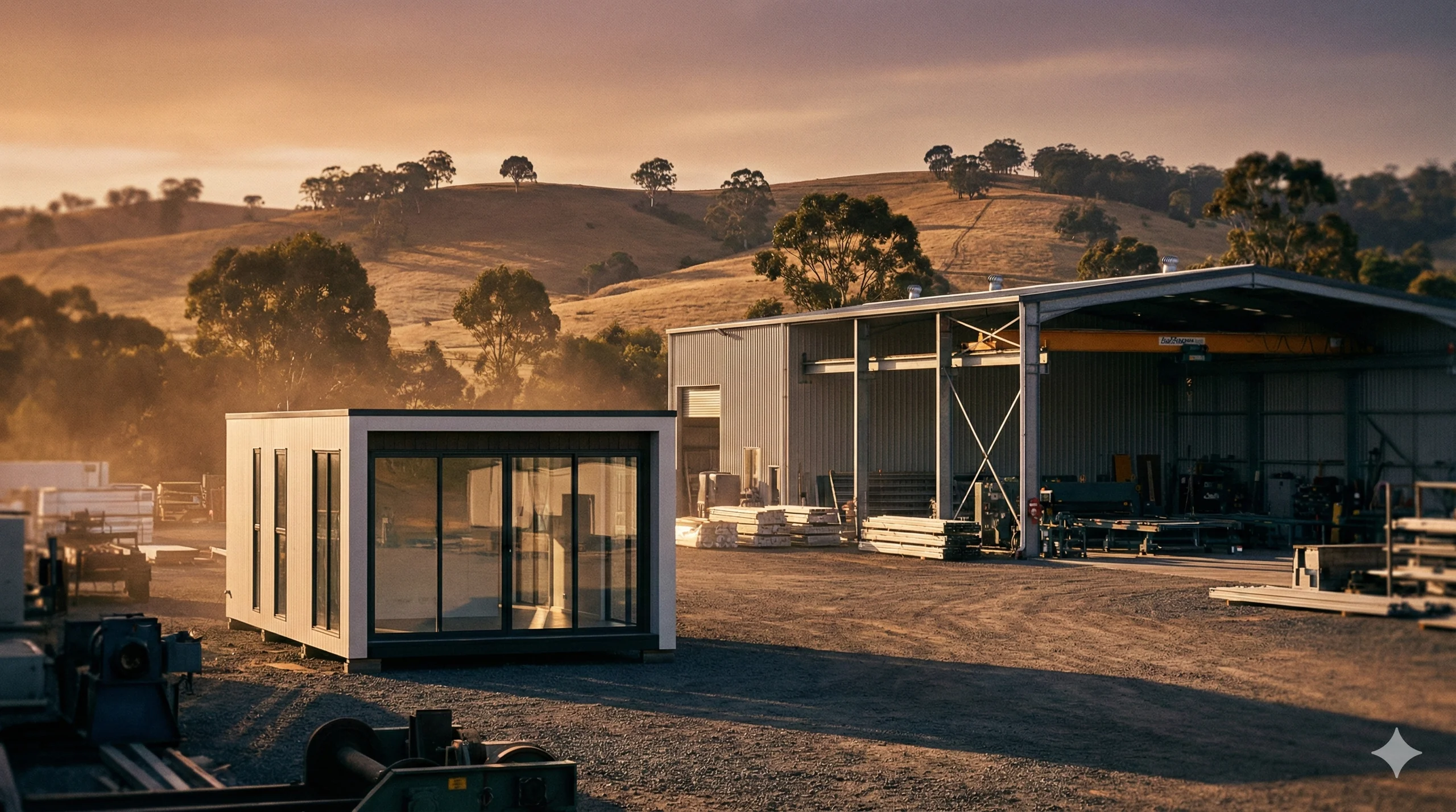
For a typical block in metropolitan or regional Victoria with ready trade availability, however, factory efficiencies are currently absorbed by transport regulation, financial risk premiums, and upgraded energy requirements. The popular image of modular homes as cheaper, simpler, and faster is, for now, still a myth.
Sources & Data
- Transport: NHVR Fee Notice 2025 [9]; VicRoads Oversize/Overmass Permits [8]
- Finance: CBA Prefabricated Housing Policy; valuation data [15]
- Regulation: NCC 2022 thermal bridging requirements [16]
- Market pricing: Pre-fab & modular cost analysis 2025 [18, 2]